What a Car Emergency Kit Is
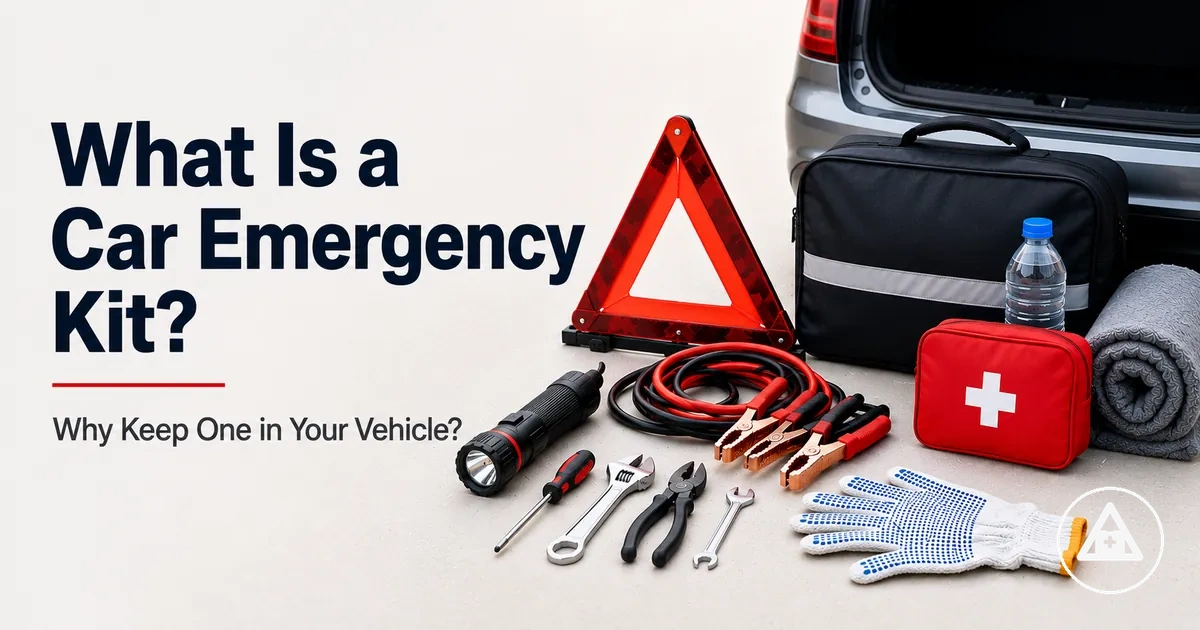
A car emergency kit is a prepared set of basic supplies kept in a vehicle to support roadside preparedness during an emergency. It helps the driver respond to common problems such as a breakdown, delay, low visibility, or waiting for help, while keeping the kit’s purpose inside the vehicle-preparedness context.
A car emergency kit supports safety by making useful supplies available before a roadside problem becomes harder to manage. Items such as a light, warning item, first aid supply, or power support may help in many cases, but their usefulness depends on the location, weather, traffic, emergency type, and available assistance.
This page defines the car emergency kit as an entity before moving into contents, use, selection, or maintenance. The focus stays on meaning, purpose, vehicle context, and realistic limits, so the next section can explain the basic purpose without turning the introduction into a checklist.
A preparedness kit can support waiting, visibility, communication, and minor personal needs, but it does not replace professional roadside assistance or mechanical repair when the vehicle problem is serious or unsafe to handle.
Car Emergency Kit Meaning and Basic Purpose
A car emergency kit is a prepared set of supplies kept in a vehicle for common roadside, delay, or waiting situations. The meaning of a car emergency kit is tied to preparedness rather than repair, with supplies stored and ready before an emergency occurs. Its basic purpose is to provide support during everyday driving situations that may require a basic response.
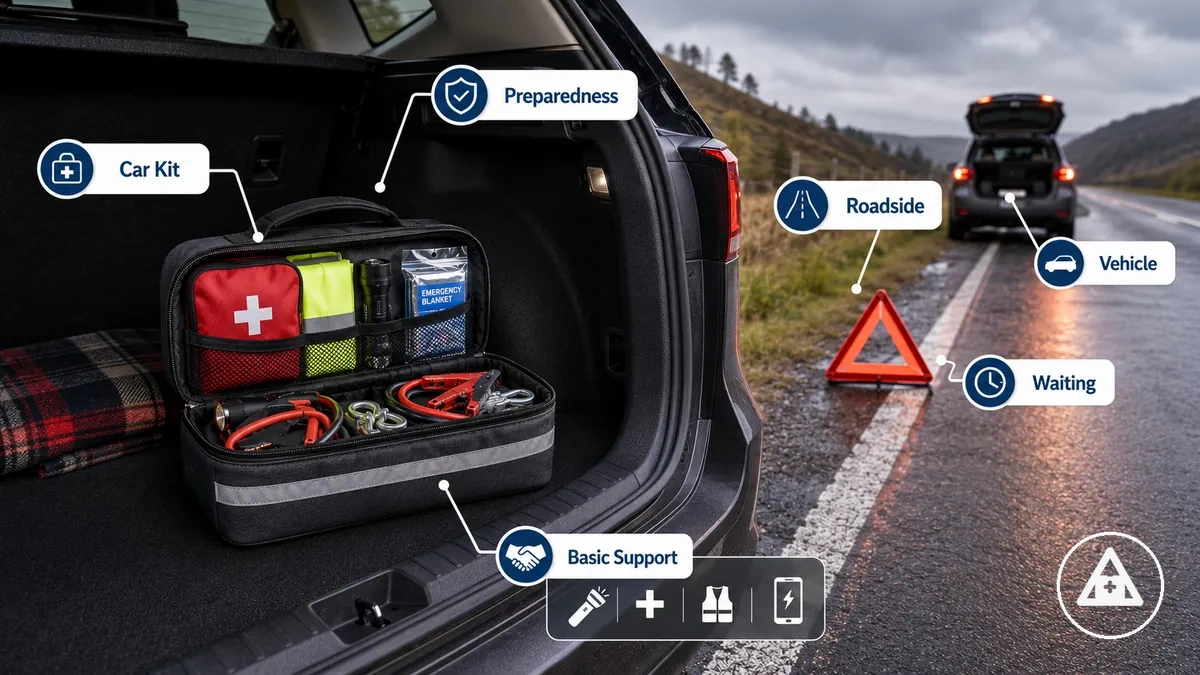
Car Emergency Kit Meaning and Basic Purpose explains why the kit is kept in the vehicle before it is needed. A car emergency kit is commonly stored in an accessible vehicle space so it can support roadside preparedness during delays, waiting situations, or minor problems while help is being arranged. A car emergency kit may support safer waiting or a basic response when conditions allow and assistance is still on the way.
A simple example is a vehicle that experiences a roadside delay and the driver must wait for assistance to arrive. In that situation, a car emergency kit can provide basic support during the waiting period, but it does not replace trained help. For broader preparedness information, continue with the car emergency kit guide.
What a Car Emergency Kit Helps With
A car emergency kit helps with common roadside situations where basic support may be needed during a breakdown, delay, or other vehicle problem. It can support visibility, first aid, communication, and short-term comfort needs while help is being arranged. Its role is to provide support, not to guarantee a solution for every emergency situation.
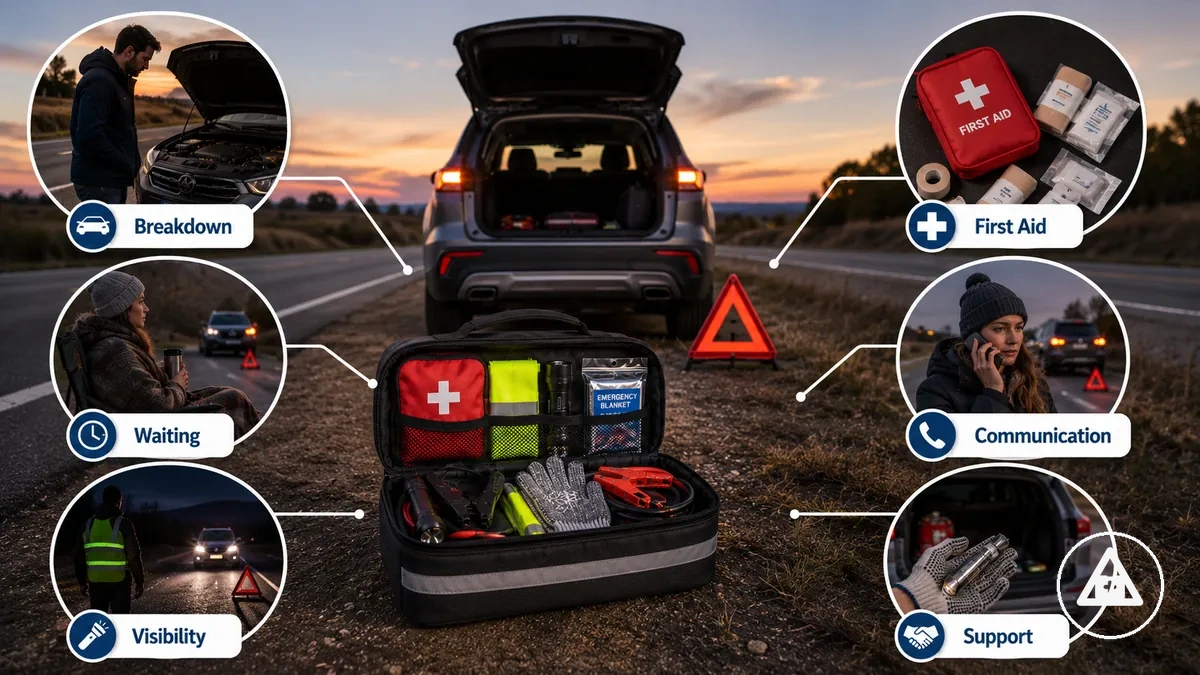
What a Car Emergency Kit Helps With can be understood through the types of situations it is designed to support. These situations often involve waiting, low-light conditions, minor first aid needs, or basic response needs during a roadside issue. The list below organizes common support situations by need type.
The usefulness of a car emergency kit depends on the vehicle problem, location, weather, traffic conditions, passenger needs, and how quickly assistance becomes available. A kit may make an emergency situation easier to manage in some cases, but serious breakdowns or safety risks can still require outside help.
- Roadside breakdown: Provides basic support while waiting for assistance, but may not resolve the underlying vehicle problem.
- Travel delay: Supports comfort and communication needs during extended waiting, although conditions vary by location and weather.
- Low visibility: Helps with visibility and warning needs in low-light conditions, but cannot remove traffic-related risks.
- Minor first aid need: Supports basic first aid or personal care needs, but does not replace professional medical care when required.
- Short-term emergency situation: Assists with basic response and preparedness, but may not be sufficient for every emergency type.
Roadside breakdowns and vehicle problems
A roadside breakdown or minor vehicle problem is a common situation where a car emergency kit can provide support. During a breakdown situation, the kit may help with visibility, communication, or short-term waiting needs while assistance is being arranged. This support has a limitation because a car emergency kit is not a repair solution for mechanical failures.
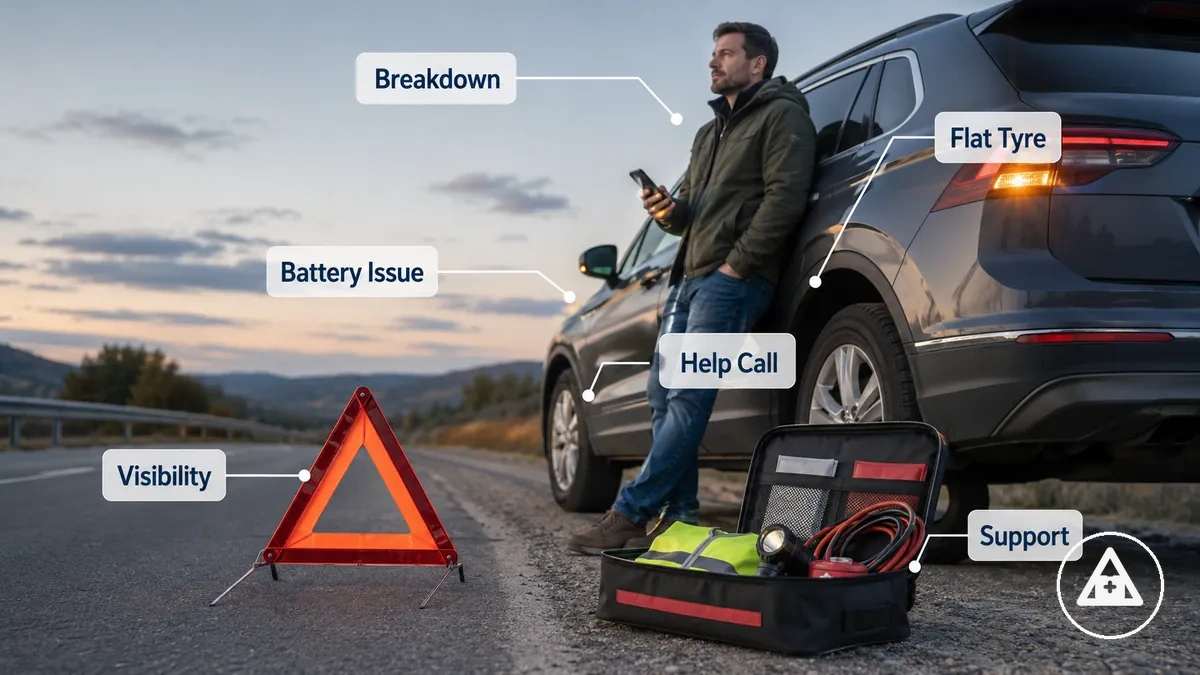
A flat tyre may make warning or visibility items useful while waiting near the roadside, but the kit may not resolve the tyre problem itself. A battery issue may make communication or power support items useful, yet a restart depends on the cause of the problem and available assistance. During low visibility or a roadside delay, warning items can support awareness of the breakdown situation, but outcomes vary with conditions and traffic. Serious vehicle problems may still require professional help.
Stranding, waiting, and short-term safety needs
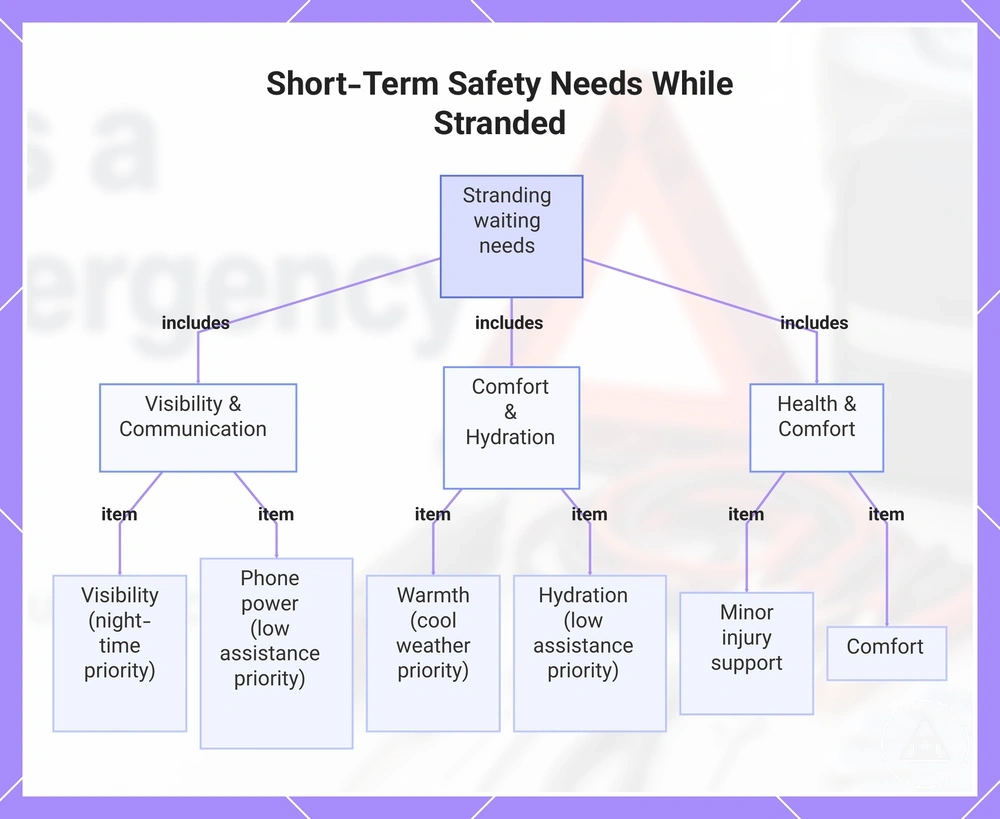
When a driver is stranded and waiting for help, attention often shifts from the vehicle problem to short-term safety and temporary support needs. A car emergency kit can help maintain visibility, communication, and basic comfort during a delay. These needs are related to waiting for assistance rather than repairing the vehicle.
Stranding, waiting, and short-term safety needs can change with conditions. A night-time delay may increase the importance of visibility, while cooler weather may make warmth and comfort more relevant. When assistance is less accessible, phone power and hydration may become more important for communication and well-being. The kit can provide temporary support, but needs vary by conditions and available help.
The checklist below helps verify common temporary support needs while waiting for assistance.
- Visibility: May support awareness during a roadside stop, especially in low-light conditions.
- Phone power: Can help maintain communication while waiting for help.
- Warmth: May improve comfort during a delay when conditions are cooler.
- Hydration: Can support short-term comfort while assistance is on the way.
- Minor injury support: May help with basic first aid needs until further care is available.
- Comfort: Can make a temporary waiting period easier for drivers or passengers.
This chart shows the main temporary support needs addressed by a car emergency kit while waiting for assistance, including how conditions affect priorities.
Basic Item Groups in a Car Emergency Kit
Basic Item Groups in a Car Emergency Kit are functional categories that organize supplies by purpose rather than by individual products. A basic car emergency kit commonly includes item groups related to first aid, visibility, lighting, power, tools, water, food, and comfort. These categories help explain how different supplies support roadside situations through distinct functions.
Basic Item Groups in a Car Emergency Kit can be organized by function, condition, and practical limitation. The table below groups common item categories by purpose instead of presenting a complete checklist. For more detailed category and item-level information, see what a car emergency kit contains.
| Item group | Main function | Helps when | Practical limit |
|---|---|---|---|
| First aid | Support minor injury and personal care needs | Minor injury or discomfort occurs | May not be sufficient for more serious medical needs |
| Visibility | Improve awareness of a roadside situation | Roadside stops or low-light conditions occur | Cannot remove traffic-related risks |
| Lighting | Provide temporary illumination | Night-time or reduced-visibility conditions occur | Effectiveness depends on conditions and use |
| Power | Support communication and device access | Phone power is needed while waiting | May not resolve the underlying vehicle problem |
| Tools | Provide basic roadside support | A minor vehicle-related need arises | Not a substitute for major repair work |
| Water, food, and comfort | Support short-term waiting needs | Delays extend or comfort becomes a concern | Needs vary by conditions and trip circumstances |
Specific item groups can vary by driving context, vehicle type, climate, passenger needs, and trip length. A kit used mainly for urban driving may emphasize different supply groups than one used for longer travel or less accessible routes. The most relevant kit categories depend on the conditions a driver may encounter.
First aid and personal care items
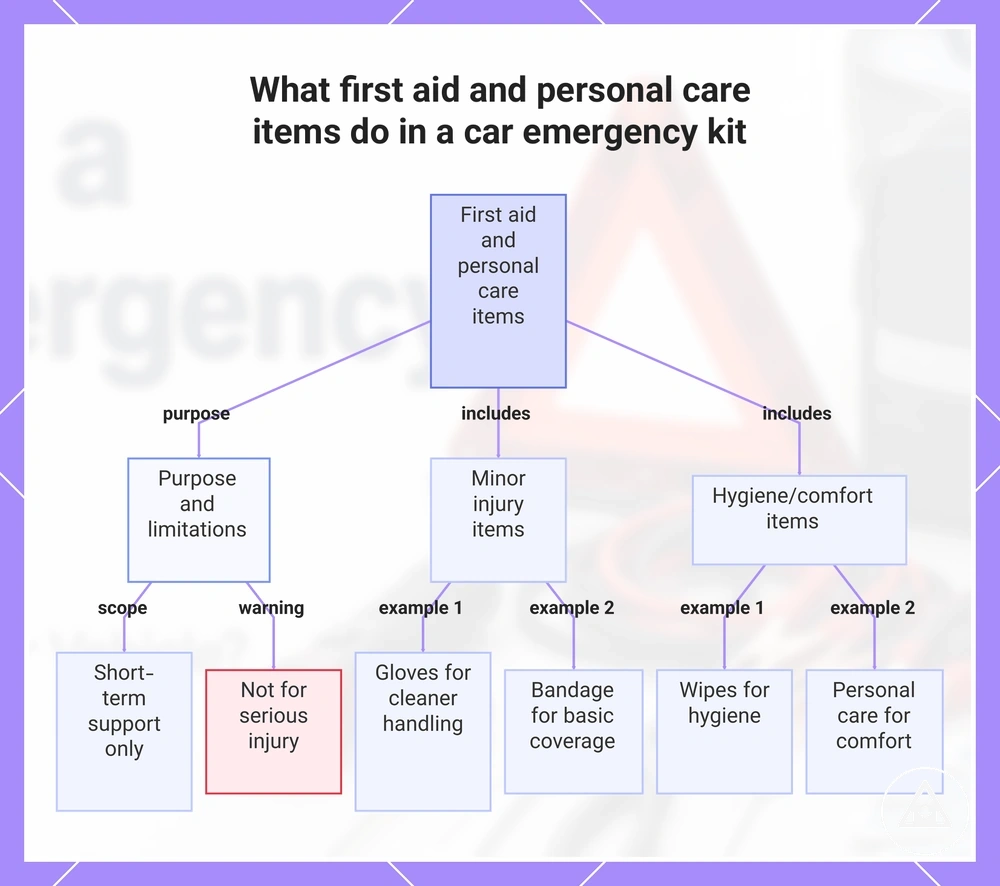
First aid and personal care items are a local safety-support group within a basic car emergency kit that help with minor injury, hygiene, and comfort needs during a roadside delay. These items can support short-term situations while waiting for help and may assist with basic care needs. Their purpose remains limited to minor support rather than broader medical response.
- Gloves: Support cleaner handling of minor injury or personal care situations, but do not replace qualified medical support.
- Bandage: Can help provide basic coverage and support for a minor injury, although suitability depends on the condition.
- Wipes: Support hygiene and comfort needs when cleanliness becomes a concern during a delay.
- Personal care items: May help maintain comfort during short waiting periods, but usefulness varies by conditions and individual needs.
If a serious injury is involved, emergency services may be needed because first aid and personal care items are intended for short-term support only.
This chart shows the purpose of first aid and personal care items in a basic car emergency kit, the key items included, and their limitations.
Visibility and warning items
Visibility and warning items are intended to make a stopped vehicle or driver more noticeable in roadside conditions. When traffic, low-light conditions, or limited visibility are involved, these warning items can help improve awareness of a roadside situation. Their main function is to support visibility and warning signals that may increase awareness.
Visibility and warning items can help make a driver or vehicle more visible, but being more visible is not the same as being fully protected. Their usefulness may vary with traffic, weather, road layout, and other conditions. For broader information about related roadside safety items, see the dedicated safety-focused section.
- Warning triangle: Supports roadside awareness by helping signal that a vehicle is stopped, but awareness outcomes depend on surrounding conditions.
- Reflective vest: Uses reflective material to help make a driver more noticeable in low-light situations, though visibility can still vary.
- Light: Provides illumination or visibility support during low-light conditions, but does not create complete protection.
- Reflective items: Can help improve visibility in roadside environments, although effectiveness depends on circumstances and use.
Power, lighting, and roadside tool items
Power, lighting, and roadside tool items are practical support components that help with common roadside visibility, communication, and convenience needs. A flashlight supports lighting in low light, while batteries or a power bank can help keep communication devices available during a delay. These items are grouped by power, lighting, and roadside tools based on their support function.
The usefulness of power, lighting, and roadside tool items depends on the situation, vehicle, driver ability, and safe use conditions. Jumper-related support may assist with a battery issue in some cases, while tyre-related support and basic tools may help address minor roadside needs when appropriate for the vehicle and user. Their purpose is roadside support rather than repair, and each item has a limitation based on compatibility, conditions, or safe use.
- Flashlight: Provides lighting support in low-light conditions, but visibility still depends on the surrounding environment.
- Batteries or power bank: Support phone power and communication during a delay, but available power varies by device and condition.
- Jumper-related support: May assist during a battery issue, although usefulness depends on vehicle requirements and safe use.
- Tyre-related support: Can help with certain roadside situations, but suitability depends on the vehicle, equipment, and driver ability.
- Basic tools: Provide simple roadside support functions, but are not a substitute for advanced repairs or specialist equipment.
Water, food, and comfort items
When a roadside delay lasts longer than expected, waiting conditions can create short-term comfort needs for drivers and passengers. Water, food, and comfort items help support basic well-being during a delay, especially when weather, route conditions, or waiting time become factors. In this context, comfort refers to short-term support rather than survival planning.
Water, food, and comfort items can help make waiting more manageable when assistance is delayed. Water and non-perishable snacks support basic needs, while a blanket, gloves, and other comfort supplies may help with warmth and comfort in changing weather conditions. Their importance can vary depending on passengers, families, longer drives, remote routes, and the specific waiting situation.
- Water: Supports hydration during a delay, but suitable amounts depend on conditions and waiting time.
- Non-perishable snacks: Help address short-term food needs while waiting, although individual needs may vary.
- Blanket: Provides warmth support during cooler weather, but comfort levels depend on conditions and delay length.
- Gloves: Help maintain comfort in colder conditions, though usefulness varies with temperature and activity.
- Comfort supplies: Support passengers during waiting periods, but the most relevant items depend on the situation.
What a Car Emergency Kit Is Not Meant to Replace
A car emergency kit is not meant to replace professional services, vehicle care, or driving preparation. Its purpose is to support readiness during a roadside situation, while many outcomes still depend on trained help, vehicle condition, or external support. This support-versus-replacement distinction helps prevent unsafe expectations and clarifies the kit’s limits.
What a Car Emergency Kit Is Not Meant to Replace becomes clearer when its support function is compared with services and responsibilities that remain separate. The table below highlights where a kit can help and where external help, repair capability, or preparation may still be needed.
| Car emergency kit can support | It does not replace |
|---|---|
| Basic roadside readiness while waiting during a breakdown | Roadside assistance that may provide trained help, recovery, or repair-related support |
| Short-term support during an emergency situation | Emergency services when serious injury, danger, or urgent response is involved |
| Preparedness for minor roadside needs | Vehicle maintenance that helps address vehicle condition and preventive care |
| Access to basic supplies during a delay | Insurance coverage, policy benefits, or claim-related services |
| Readiness items that support a journey | Proper driving preparation, planning, and driver responsibility |
A car emergency kit can improve readiness and help manage common roadside situations, but it cannot substitute for every form of external help. Roadside assistance, emergency services, vehicle maintenance, insurance, and driving preparation each address different needs beyond the kit’s support function. The level of support required often depends on the situation, vehicle condition, and available assistance.
Why Keeping a Car Emergency Kit in the Vehicle Matters
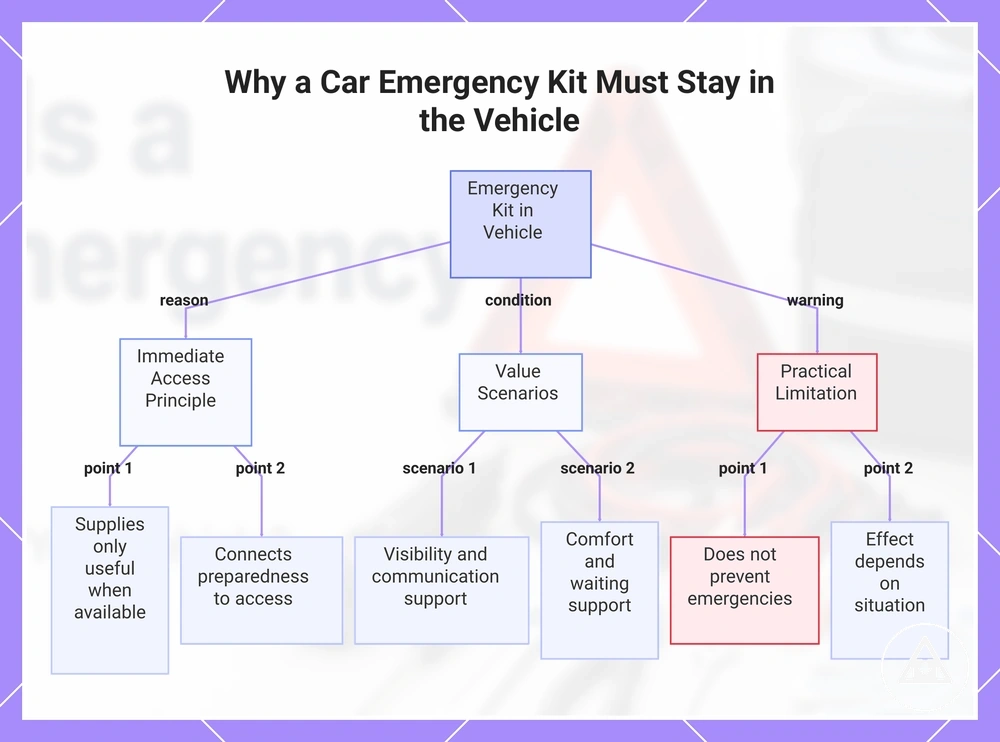
Keeping a car emergency kit in the vehicle matters because preparedness depends on access during unexpected roadside conditions. Supplies are only useful when they are available at the time they are needed, whether the situation involves a delay, low-light conditions, weather, or waiting for help. Keeping in the vehicle connects preparedness directly to immediate access.
Unexpected roadside conditions often involve time pressure, changing weather, limited visibility, or passenger needs. When ready supplies are carried in the vehicle, drivers and passengers may be able to respond more efficiently to immediate needs while assistance is being arranged. This immediate access can support communication, comfort, or basic response needs during a roadside event.
Why Keeping a Car Emergency Kit in the Vehicle Matters becomes clearer through situations where access provides practical value:
- Low-light stop: Immediate access may support visibility or communication when conditions become darker than expected.
- Weather-related delay: Ready supplies can help address short-term comfort needs while waiting for help during changing weather conditions.
- Passenger needs: Access to support items may help when passengers require additional comfort during a roadside delay.
- Unexpected waiting period: Keeping supplies in the vehicle allows them to be available when assistance takes longer than expected.
A car emergency kit supports response and readiness, but it does not prevent emergencies or remove the need for external help. Its practical effect depends on the condition, the roadside situation, available assistance, and the needs of passengers while waiting for help.
This chart explains why keeping an emergency kit in the car matters, focusing on the immediate access principle, key scenarios where access provides value, and the kit's limitations.
When a Starter Car Emergency Kit Is Enough
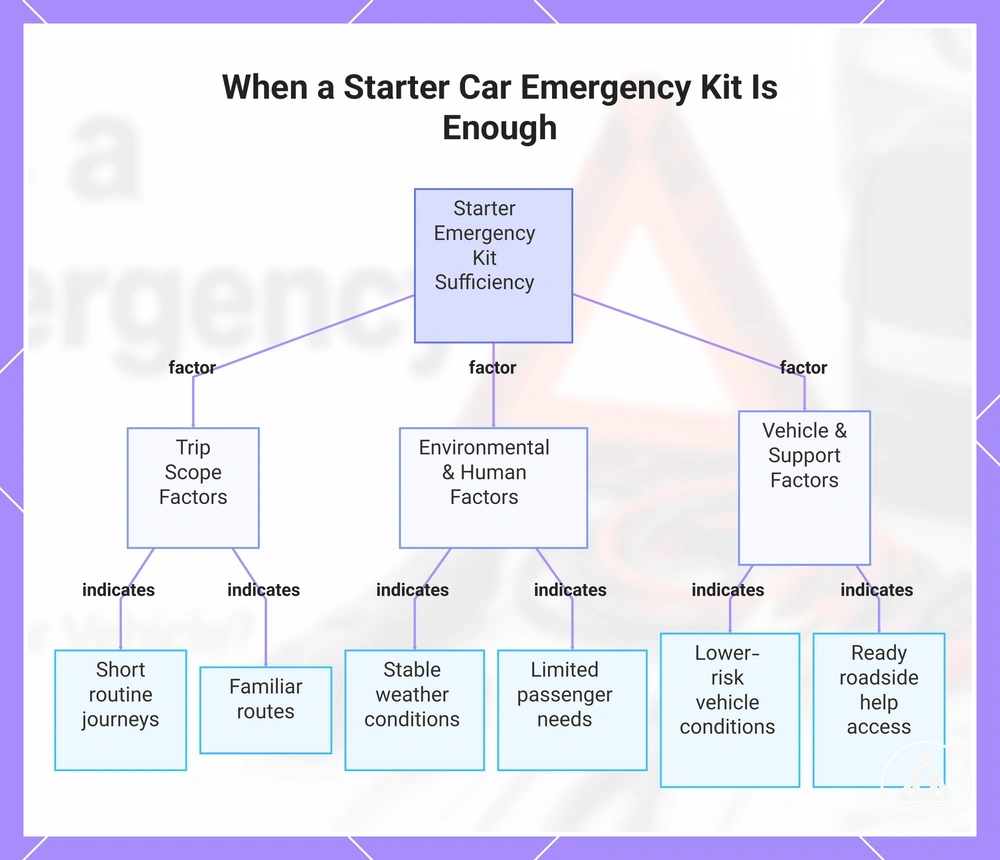
A starter car emergency kit is enough for basic preparedness when driving conditions are relatively predictable and roadside needs are likely to remain limited. It can suit many everyday driving situations where roadside help is reasonably accessible and risk factors are lower. Whether a starter car emergency kit is enough depends on driving context.
Basic preparedness should match the roadside conditions a driver is most likely to encounter. Driving distance, route familiarity, weather exposure, passenger needs, vehicle age, and access to roadside help can influence whether a starter kit remains sufficient or whether additional preparedness may be needed. When a Starter Car Emergency Kit Is Enough can be assessed by checking the fit conditions below.
- Driving distance: Short and routine journeys may be an enough signal, while frequent long-distance driving may be a not-enough signal.
- Route familiarity: Familiar routes may support a starter kit being enough, while remote or unfamiliar routes may indicate a need for additional preparedness.
- Weather exposure: Stable weather conditions may be an enough signal, while seasonal extremes or changing conditions may be a not-enough signal.
- Passenger needs: Limited passenger requirements may align with a basic kit, while greater comfort or support needs may suggest a starter kit is not enough on its own.
- Vehicle age: Lower-risk vehicle conditions may support starter-level preparedness, while older vehicle age may increase preparedness requirements.
- Roadside help: Ready access to roadside help may be an enough signal, while limited access to assistance may indicate that a starter kit is not enough for the driving context.
A starter car emergency kit can provide enough support for many everyday driving situations focused on basic preparedness. Longer travel distances, greater weather exposure, higher passenger needs, older vehicle age, or reduced access to roadside help may shift the decision toward additional preparedness. The appropriate level of readiness depends on the driver’s circumstances and likely roadside conditions.
This chart shows the key driving context factors that indicate a starter car emergency kit is sufficient.
Common Car Emergency Kit Questions
Common car emergency kit questions usually focus on meaning, usefulness, suitability, and limits. The answers below address residual clarifications that may remain after reviewing the main car emergency kit concepts.
What is a car emergency kit meant to do?
A car emergency kit is meant to support basic roadside preparedness. It helps address common short-term needs that may arise during a delay, breakdown, or unexpected roadside situation.
Does a basic kit include everything a driver might need?
No, a basic kit does not include everything for every situation. Suitability depends on driving conditions, weather exposure, passenger needs, and access to roadside help.
Should a car emergency kit stay in the vehicle?
Yes, a car emergency kit should generally remain in the vehicle when it is intended for roadside use. Keeping the kit available supports access during unexpected roadside conditions.
Can a starter kit support everyday driving needs?
A starter kit can support basic preparedness for many everyday driving situations. Whether it is enough depends on driving distance, route familiarity, vehicle age, and access to roadside help.
When is a starter car emergency kit not enough?
A starter car emergency kit may not be enough when driving conditions involve greater demands or risk. Longer journeys, remote routes, changing weather exposure, or higher passenger needs may require additional preparedness.
Why does a car emergency kit matter?
A car emergency kit matters because roadside situations can create immediate support needs. Having a basic kit available in the vehicle can help drivers and passengers respond more effectively while waiting for assistance.
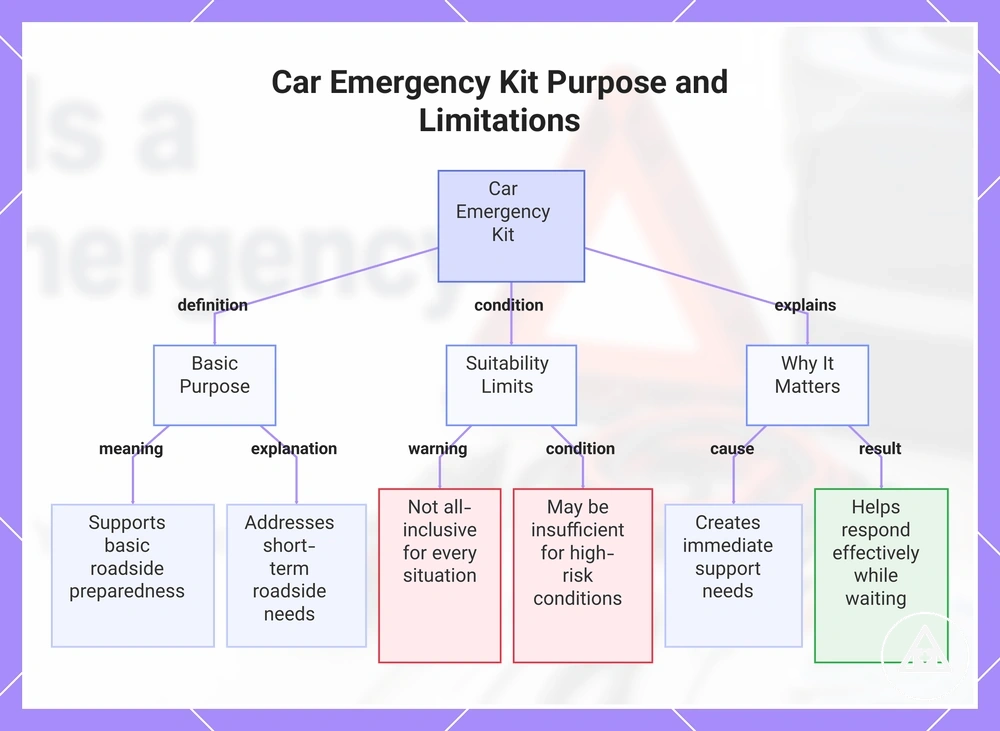
This chart shows the basic purpose of a car emergency kit, when it may be sufficient or insufficient, and why it matters for roadside preparedness.